Storm rain leaves Sussex facing severe drought
Storms have brought rain back to Sussex, but how much water is needed to rebuild its depleted supplies?
On October 25, reporting showed parts of Sussex remained in severe drought after two named storms, with South East Water restricting reservoir releases.
Storm Austen and Storm Boelo brought rain and damage to Sussex, while Boelo also brought flooding to parts of northern Britain. Yet parts of Sussex remained in severe drought because the designation reflects depleted reservoirs, not simply current rainfall. [6][9] Ardingly Reservoir, serving 280,00…
Open original (2 sources):
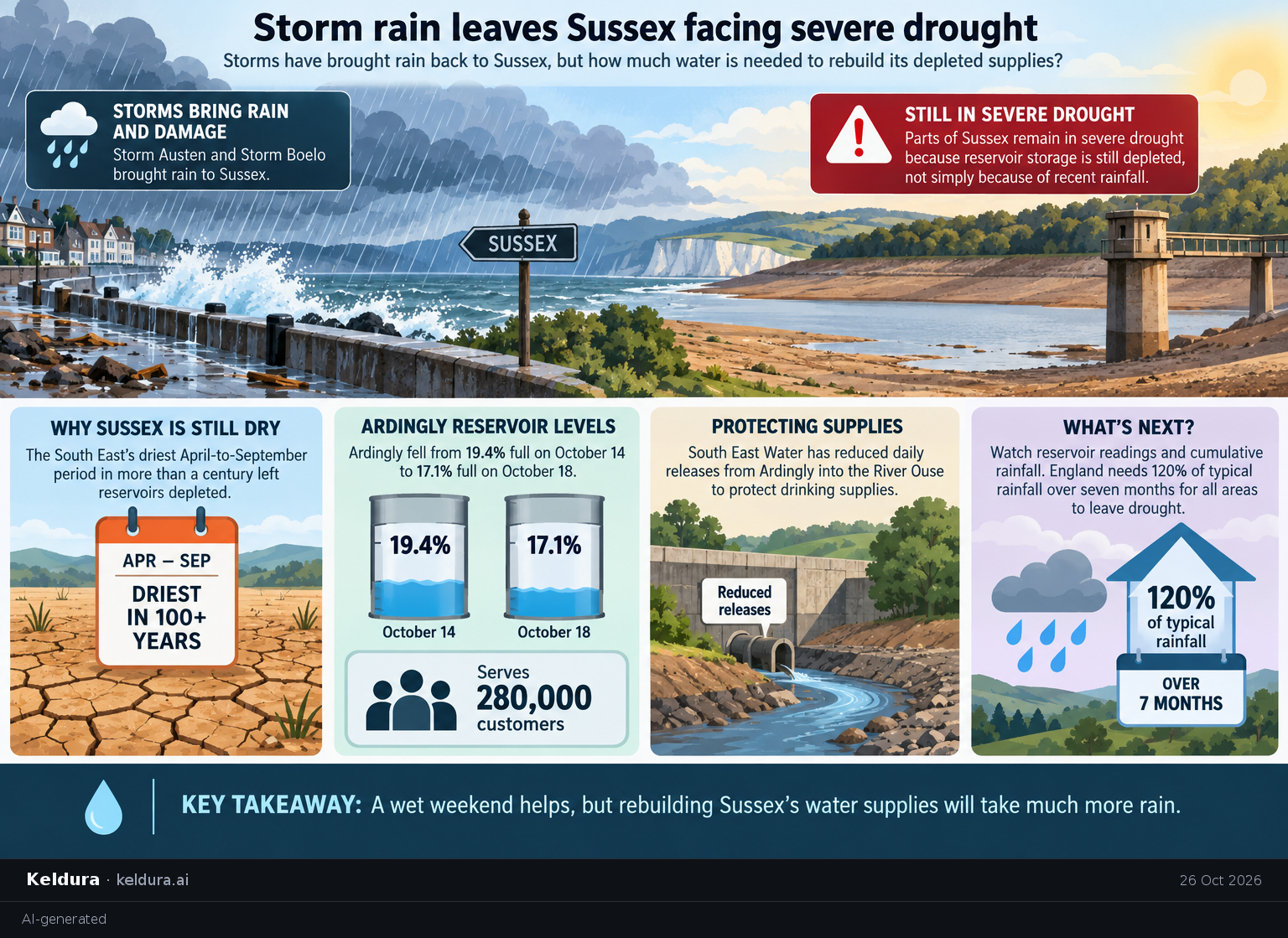
Storm Austen and Storm Boelo brought rain and damage to Sussex, while Boelo also brought flooding to parts of northern Britain. Yet parts of Sussex remained in severe drought because the designation reflects depleted reservoirs, not simply current rainfall. [6][9] Ardingly Reservoir, serving 280,000 customers, fell from 19.4% full on October 14 to 17.1% on October 18. [6]
Why it matters: A wet weekend does not necessarily restore drinking-water security: South East Water has reduced daily releases from Ardingly into the River Ouse to protect supplies, linking the reservoir shortage directly to river management. [6]
Key insights: The South East experienced its driest April-to-September period in more than a century, leaving a deficit that individual storms cannot automatically erase. [6] | Environment Agency and government research said England needed 120% of typical rainfall over the following seven months for all areas to leave drought. [6] | New storage is a longer-term response: South East Water's proposed Broad Oak reservoir would begin supplying water in 2035 if approved under its stated timetable. [6]
Cheatsheet facts: What happened: Storm rain returned, but parts of Sussex remained in severe drought because reservoir storage was still depleted. [6] | Why: The South East's driest April-to-September period in over a century left Ardingly just 17.1% full on October 18. [6] | Who pays: Ardingly serves 280,000 customers, and South East Water has reduced releases into the River Ouse to protect drinking supplies. [6] | What's next: Watch reservoir readings and cumulative rainfall: the published England-wide recovery benchmark was 120% of typical rainfall over seven months. [6]
X copy pack
Edition complete
You've reached the end of this edition.