Sri Lanka freezes new Mannar wind projects amid local opposition
Sri Lanka needs renewable electricity, but can Mannar's wind expansion proceed without resolving residents' complaints?
On October 25, AFP reported that Sri Lanka had frozen new wind projects in Mannar while allowing already approved projects to proceed.
Sri Lanka has frozen new wind projects in Mannar amid residents' complaints about declining fish catches and flooding, while allowing already approved developments to proceed. [1] The state utility's first 30 turbines entered service in 2020 with 104 megawatts of capacity, and construction of anoth…
Open original · [1] Sri Lankan turbine project fuels anger as fish hauls plunge | AFP.com — afp.com
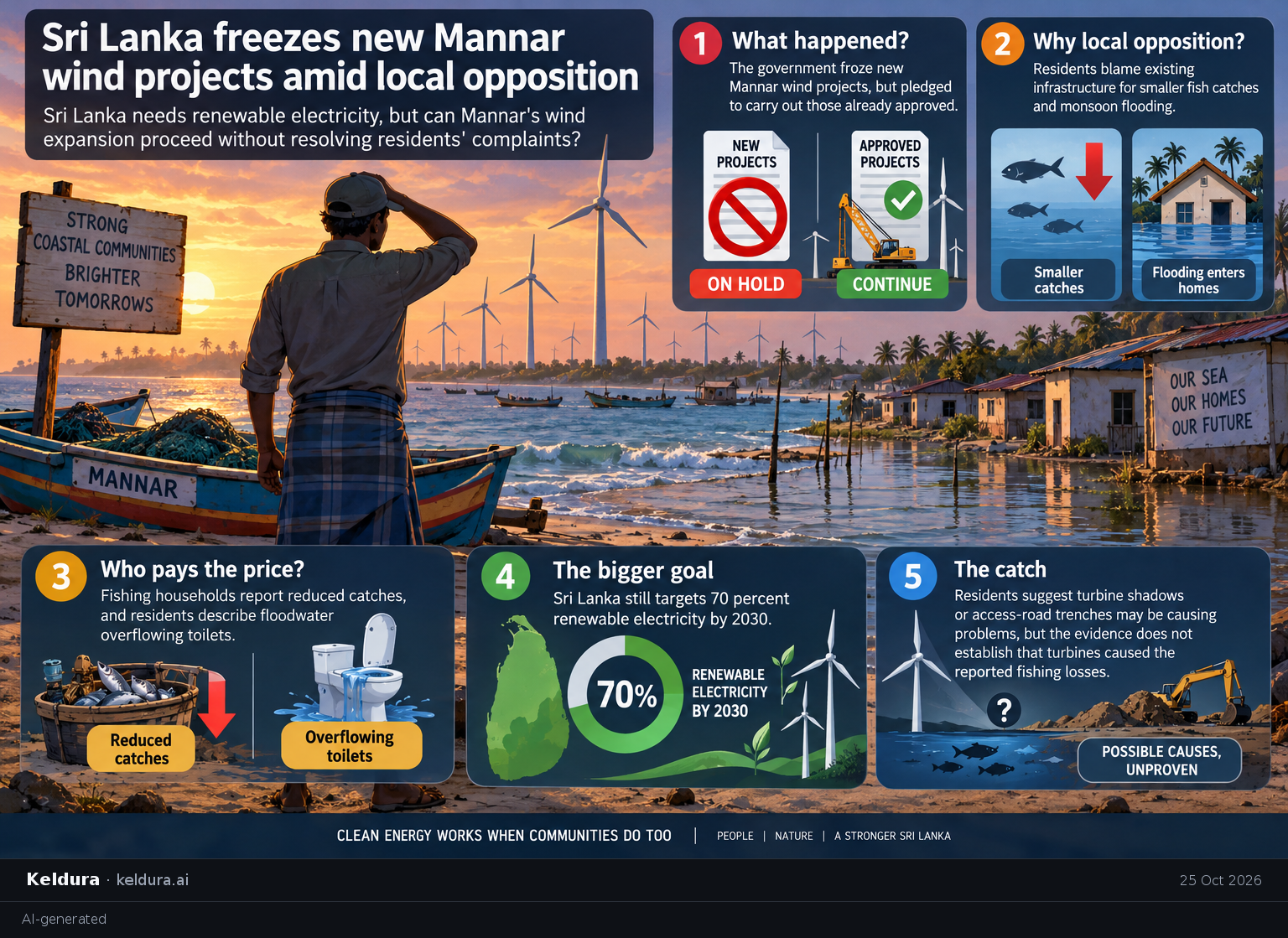
Sri Lanka has frozen new wind projects in Mannar amid residents' complaints about declining fish catches and flooding, while allowing already approved developments to proceed. [1] The state utility's first 30 turbines entered service in 2020 with 104 megawatts of capacity, and construction of another 14 has begun. [1] Residents attribute local problems to the infrastructure, but the fisherman interviewed acknowledged having no proof that turbine shadows were driving fish away. [1]
Why it matters: Sri Lanka aims to obtain 70 percent of its electricity from renewable sources by 2030, making local acceptance consequential for its energy transition as fuel and electricity costs rise. Mannar shows that a national energy target does not resolve disputes over the local costs of building it. [1]
Key insights: The freeze distinguishes new proposals from projects already approved: construction is continuing rather than stopping altogether. [1] | Residents describe two different possible mechanisms—turbine shadows affecting fish and foundations or access-road trenches obstructing drainage—but the evidence supplied does not establish either causal link. [1] | Price is another constraint: the government cancelled a separate 52-turbine contract awarded to Adani in 2025 after a dispute over the electricity tariff. [1]
Cheatsheet facts: What happened: The government froze new Mannar wind projects but pledged to carry out those already approved. [1] | Why: Residents oppose further construction, blaming existing infrastructure for smaller catches and monsoon flooding. [1] | Who pays: Fishing households report reduced catches, while residents describe floodwater entering homes and overflowing toilets. [1] | The catch: Sri Lanka still targets 70 percent renewable electricity by 2030, and the supplied evidence does not establish that turbines caused the reported fishing losses. [1]
X copy pack
Edition complete
You've reached the end of this edition.