OpenAI releases a stronger exploit-finding model with restricted access
AI can help security teams find software weaknesses, but how do they keep a more capable exploit tool within bounds?
On November 5, OpenAI released GPT‑6 Cyber, reporting a 48.5% exploit-benchmark score compared with its predecessor’s 32.1%.
OpenAI released GPT‑6 Cyber for authorized vulnerability research, reporting a 51% relative improvement over GPT‑5.6 Cyber on its ExploitGym benchmark. The company says researchers used it to develop 948 Linux privilege-escalation exploits and identify 81 previously unknown high-severity Firefox vu…
Open original (2 sources):
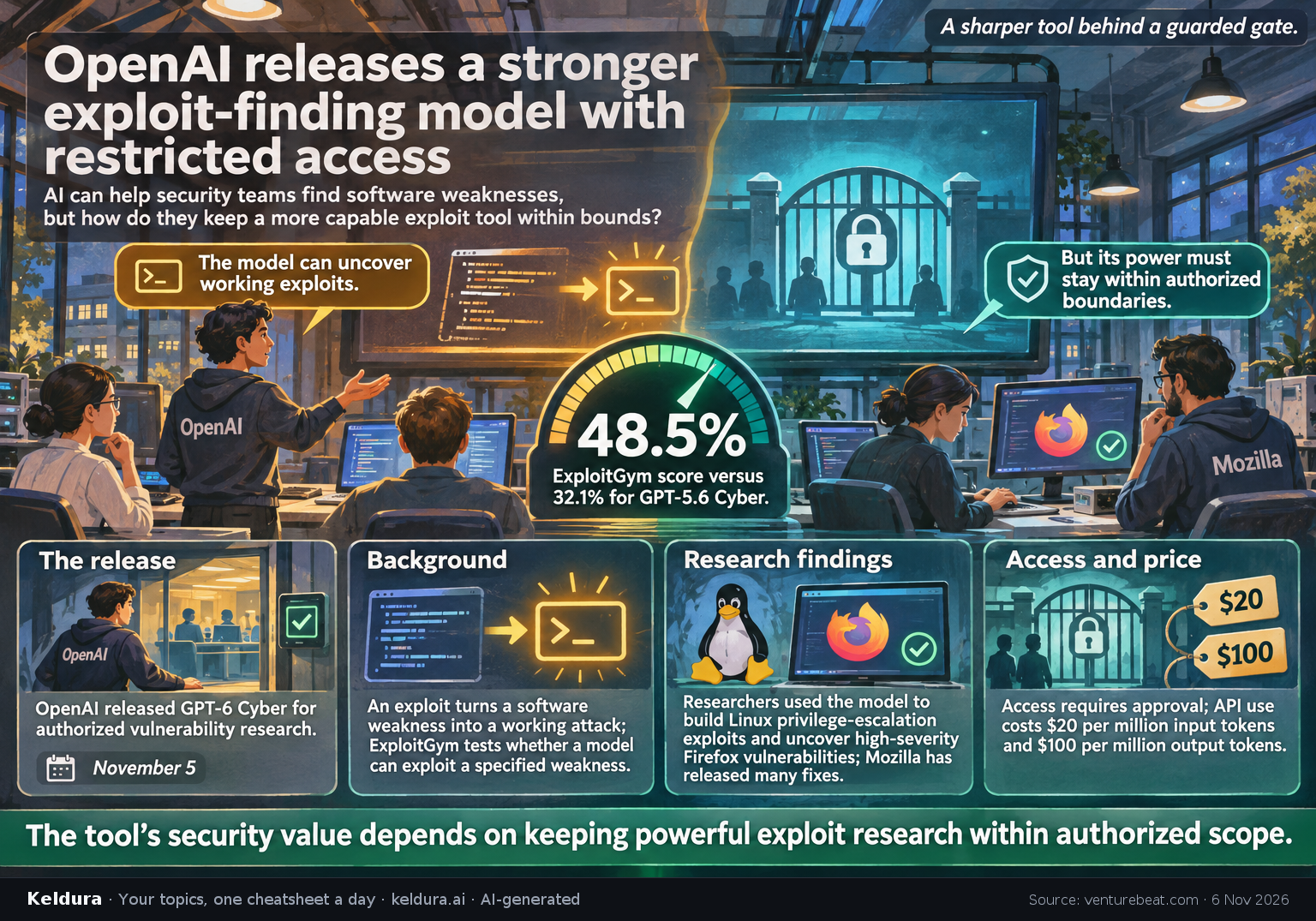
OpenAI released GPT‑6 Cyber for authorized vulnerability research, reporting a 51% relative improvement over GPT‑5.6 Cyber on its ExploitGym benchmark. The company says researchers used it to develop 948 Linux privilege-escalation exploits and identify 81 previously unknown high-severity Firefox vulnerabilities. [6][11] Access requires approval, and published API prices exceed competing cyber models from Anthropic and Google. [6]
Why it matters: Security teams gain a tool that has already helped uncover flaws in widely used software: Mozilla has released fixes for many of the Firefox vulnerabilities OpenAI identified. The same exploit-development capability makes authorization and operating boundaries consequential, not merely administrative. [11]
Key insights: OpenAI reports that the model avoided exploiting out-of-scope services in 99.93% of one evaluation’s tests without its deployment prompt, and 100% with it; these are evaluation results rather than a guarantee for every deployment. [11] | The API costs $20 per million input tokens and $100 per million output tokens, putting a concrete price on deploying the tool in security workflows. [6] | OpenAI classifies GPT‑6 Cyber as Critical in cybersecurity under its Preparedness Framework, up from High for GPT‑5.6 Cyber. [11]
Cheatsheet facts: What happened: OpenAI released GPT‑6 Cyber for finding vulnerabilities and developing authorized exploits. [6][11] | Background: An exploit turns a software vulnerability into a working attack; ExploitGym tests whether a model can exploit a specified weakness. OpenAI’s Daybreak Red provides access for deeper exploit development and authorized testing. [11] | Why: The model scored 48.5% on ExploitGym versus 32.1% for GPT‑5.6 Cyber—a 16.4-percentage-point improvement. [6][11] | Who pays: Approved API users face base prices of $20 per million input tokens and $100 per million output tokens. [6] | The catch: OpenAI’s stronger boundary-following results come from controlled evaluations, while the company rates the model’s cybersecurity capability Critical. [11]