OpenAI replaces its Git backend to support agent-scale development
Coding agents can work across many branches at once, but can the source-control system keep up without changing developers’ tools?
On November 2, OpenAI said its new Pando backend now powers all development in its monorepo while retaining Git compatibility.
OpenAI built Pando, a new backend for Git repositories, to accommodate the concurrent development work enabled by Codex, and says it now powers all development in its monorepo. The company reports that Pando reduced median push latency by nearly a factor of five and delivers nearly a petabyte of Gi…
Open original · [11] Scaling Git at OpenAI | OpenAI — OpenAI Blog
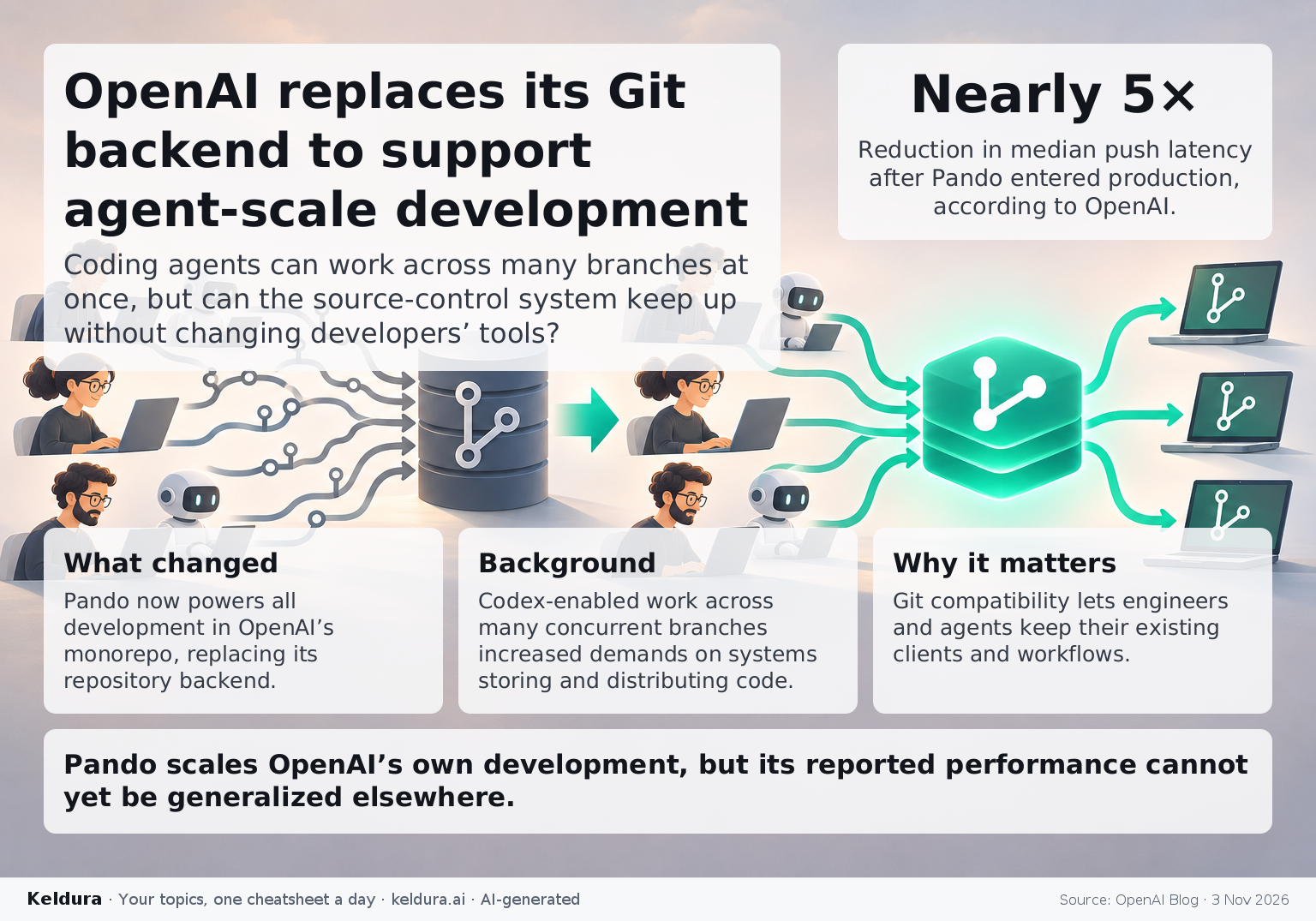
OpenAI built Pando, a new backend for Git repositories, to accommodate the concurrent development work enabled by Codex, and says it now powers all development in its monorepo. The company reports that Pando reduced median push latency by nearly a factor of five and delivers nearly a petabyte of Git data per day without requiring engineers or agents to change their Git workflows. [11]
Why it matters: The deployment illustrates a downstream constraint of AI-assisted coding: generating more concurrent work also increases demands on the systems that store and distribute code. OpenAI addressed that constraint beneath the existing Git interface rather than requiring a new client or workflow. [11]
Key insights: Pando targets two different bottlenecks: concurrent pushes across many branches and read throughput high enough to saturate clients’ available network bandwidth. [11] | Compatibility with the Git protocol and client allowed OpenAI to introduce the backend without interrupting engineering work, according to the company. [11] | The reported improvements are production results from OpenAI’s own environment, not an independent benchmark or evidence of general availability. [11]
Cheatsheet facts: What happened: Pando now runs all development in OpenAI’s monorepo behind the existing Git interface. [11] | Why: OpenAI says repository growth and the concurrent work enabled by Codex required a more scalable source-control backend. [11] | The catch: The nearly fivefold reduction in median push latency and nearly one-petabyte daily delivery figure are reported by OpenAI for its own production system. [11]