ESA advances three candidates for its next Earth Explorer
Three missions could expose different gaps in Earth's climate system, but which can turn its scientific promise into a workable satellite?
On September 25, 2026, ESA selected ECO, Keystone and CryoRad for the next preparatory phase of its twelfth Earth Explorer mission.
ESA advanced three of four candidate missions after scientific consultation and advisory review: ECO, Keystone and CryoRad. Only one will be selected for implementation as Earth Explorer 12, with launch expected around 2036. [5]
Open original · [5] ESA - Three Earth Explorer candidates go forward — ESA News
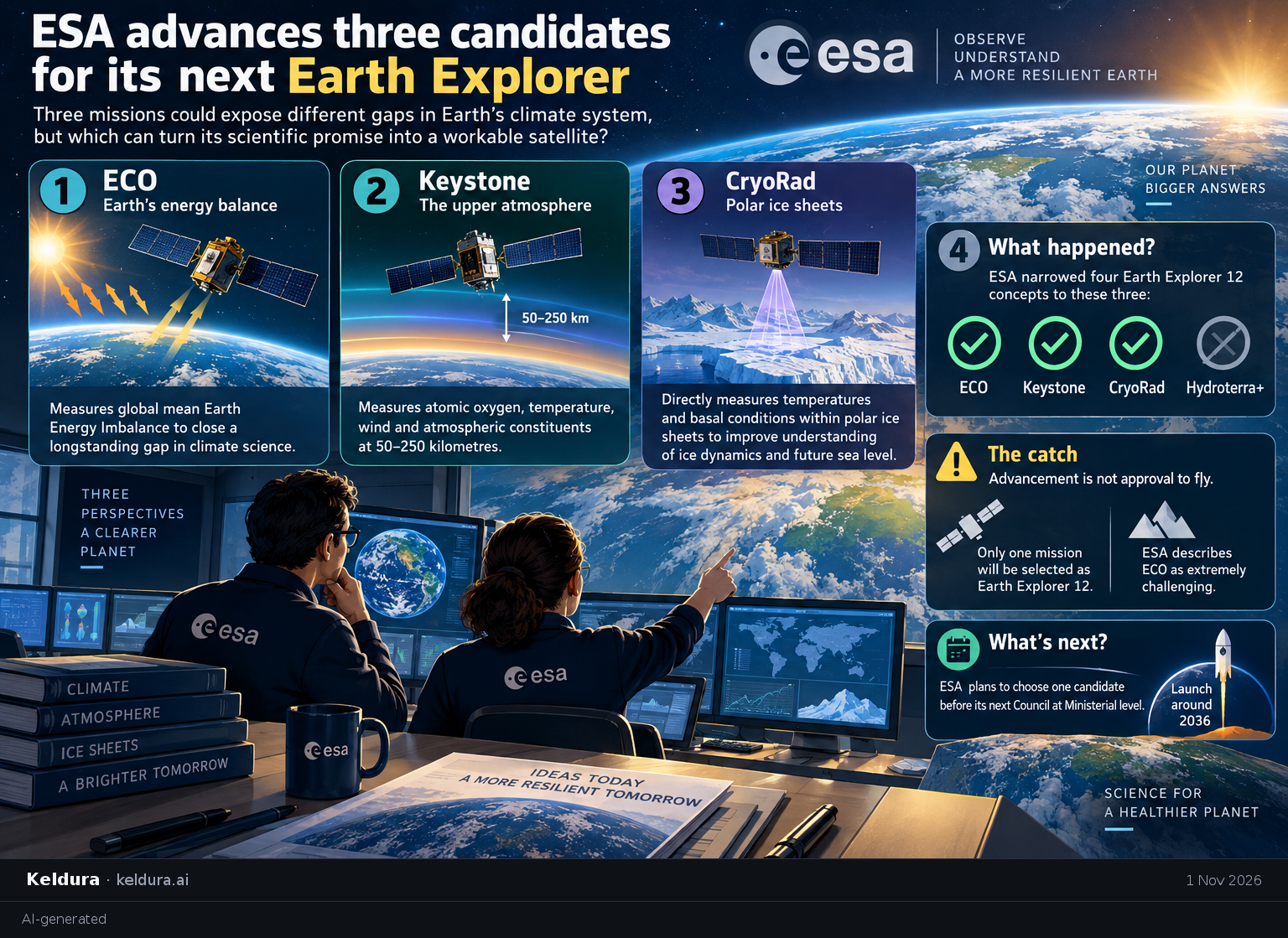
ESA advanced three of four candidate missions after scientific consultation and advisory review: ECO, Keystone and CryoRad. Only one will be selected for implementation as Earth Explorer 12, with launch expected around 2036. [5]
Why it matters: The choice will determine which measurement gap this mission addresses: Earth's energy imbalance, the upper atmosphere or conditions inside polar ice sheets. Each targets a different limitation in understanding environmental change. [5]
Key insights: ECO would target global mean Earth Energy Imbalance, which ESA's scientific adviser described as a longstanding gap in quantifying climate change and assessing mitigation. [5] | Keystone would measure atomic oxygen alongside temperature, wind and atmospheric constituents at altitudes of 50–250 kilometres. [5] | CryoRad would directly measure temperatures and basal conditions within polar ice sheets to improve understanding of ice dynamics and future sea level. [5] | The advisory ranking placed ECO first, Keystone second, CryoRad third and Hydroterra+ fourth; the board advanced the first three. [5]
Cheatsheet facts: What happened: ESA narrowed four Earth Explorer 12 concepts to ECO, Keystone and CryoRad. [5] | Why: The candidates address gaps in planetary energy accounting, upper-atmosphere observations and polar ice-sheet measurements. [5] | The catch: Advancement is not approval to fly: one mission will be selected, and ESA describes ECO as extremely challenging. [5] | What's next: ESA plans to choose one candidate before its next Council at Ministerial level; the selected mission is expected to launch around 2036. [5]
X copy pack
Edition complete
You've reached the end of this edition.