Lumina models the early universe at a much larger scale
Lumina gives astronomers a larger simulated universe, but will its predictions match what telescopes see?
On October 26, researchers from MIT, Harvard University and elsewhere presented Lumina in Monthly Notices of the Royal Astronomical Society.
Lumina follows dark matter, gas, stars and radiation through the universe’s first 2 billion years, covering more than 100 times the volume of previous comparable simulations. [2][4] It models both hydrogen and helium reionization, including how helium reionization immediately affects the evolving u…
Open original (2 sources):
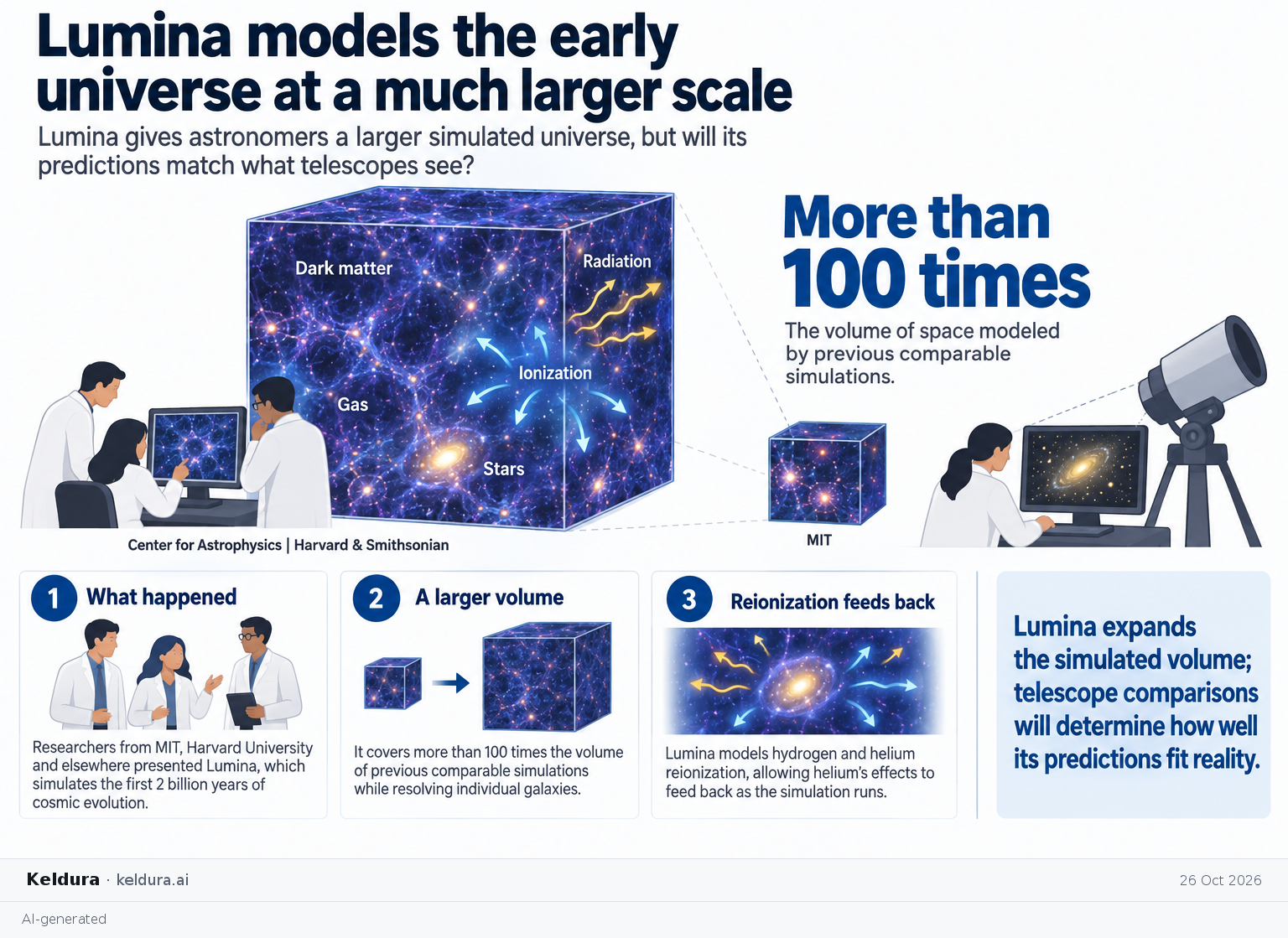
Lumina follows dark matter, gas, stars and radiation through the universe’s first 2 billion years, covering more than 100 times the volume of previous comparable simulations. [2][4] It models both hydrogen and helium reionization, including how helium reionization immediately affects the evolving universe within the simulation. [2][4]
Why it matters: Astronomers can compare Lumina’s predictions with telescope observations to test whether existing theories explain early galaxies and the gas between them; the simulation is a testing ground, not evidence that those theories are already correct. [2]
Key insights: The advance combines volume with detail: Lumina follows a large cosmic region while resolving the development of individual galaxies. [4] | Radiation is part of the evolving system, interacting with matter rather than merely illuminating a finished picture of cosmic structure. [2][4] | Hydrogen reionization let light travel more freely as ultraviolet radiation from early stars stripped electrons from neutral hydrogen. [4] | Lumina also captures helium reionization and allows its effects to feed back into the model as it runs. [2]
Cheatsheet facts: What happened: Researchers developed Lumina to simulate the first 2 billion years of cosmic evolution. [2][4] | Why: The model links dark matter, gas, stars and radiation so astronomers can examine how early galaxies changed their surroundings. [2][4] | The catch: Its predictions still need comparison with telescope observations to establish how well the modeled universe matches the real one. [2]
X copy pack
Edition complete
You've reached the end of this edition.